How much seed you Soak depends on the area you are planting - see here.
Yields vary depending on method used, climate and technique, but are roughly 7 - 8 pounds of Greens per pound of seed planted.
When growing Sunflower Greens: You really MUST Pre-Sprout before planting.
Put seed* into a bowl or your Sprouter.
Fill that which you are using with cool (60-70 degree) water.
ESSENTIAL SOAKING NOTE: Whole Sunflower Seeds float.
To get them all to soak up water well, so they grow well, it is necessary to keep them all under water.
We do this with a mason jar - topped with a screen lid, or a plate atop a bowl, or an Easy Sprout with a flat lid snapped on-top.
Whatever you use - keep them all underwater!
Allow your seeds to Soak for 8-12 hours.
Empty the seeds into your Sprouter (if necessary).
Drain off the soak water.
You may water plants with it if you like - it has nutrients in it.
Rinse thoroughly with cool (60-70°) water
then Drain thoroughly.
Set your Sprouter anywhere out of direct sunlight and at room temperature (70° is optimal) between Rinses.
This is where your sprouts do their growing. We use a counter top - in the corner of our kitchen, but where the sprouter won't get knocked over by cats, dogs, kids or us.
We don't mind the indirect sunlight or the 150 watts of incandescent light, because light just does not matter much.
A plant can only perform photosynthesis when it has leaves. Until then light has little if any effect. Sprouts also happen to like air-circulation, so don't hide your sprouts.
We'll get to the light later, after planting our Greens.
Rinse and Drain again in 8-12 hours.
And, perhaps one more...
Rinse and Drain in 8-12 hours.
And, conceivably one more...
Rinse and Drain in 8-12 hours.
When most of the seeds have sprouted tiny (1/8-1/4 inch) roots, or even better, when they are just showing the hint of a root, it is time to plant.
This is typically after just 2-3 Rinse and Drain cycles.
Planting and Growing
Soil Note: The amount of soil you use is up to you. The reality is this: As your plants grow they need more and more water. They get their water from the soil. The more soil you use - the more water it can hold = the less you need to water.
Thoroughly moisten the soil. Allow puddles to dry.
Sometimes you may need to use your fingers to make sure the soil is moist all the way down to the bottom of the tray. Water, mix, water, mix, etc. Sometimes you don't have to do that. Earthworm castings tend to be quite dry.
If you are using them, which we Strongly Advise when growing Sunflower Greens, you should add very small amounts of water to them, a little at a time, until they are moist and fluffy. They will be much easier to mix with your other soil. Remember - do not exceed 20% Earthworm castings in your soil mix.
You don't want to burn your Greens.
Baby Blanket:
Prepare the pad: Cut it to fit your Tray if necessary. Soak it in water or better yet, Kelp Fertilizer enriched water (You don't NEED fertilizer, but we use it when we grow without soil.) until thoroughly saturated (fold it up and push it into the liquid -
use a pot or something similar to hold it). Unfold it and re-fold differently or do whatever makes sense - the goal is to get the pad THOROUGHLY soaked. Spread the wet pad across the bottom of your Planting Tray. Proceed...
Vermiculite:
Vermiculite absorbs liquid so readily and holds it so thoroughly that you need less Vermiculite than you would soil. We use 3 Cups for an 10 x 10 inch tray and 6 Cups for an 10 x 20 inch tray.
If you're using another size tray, make it 1/4 - 1/2 inch deep. Spray water evenly across the surface then spread it out as evenly as you can. We like to use Kelp Fertilizer enriched water (You don't NEED fertilizer, but we use it when we grow without soil.) so we just
pour it on until thoroughly saturated and then spread it out. The amount of liquid is this: a little more than one quart for an 10 x 20 inch tray. You don't want more than a little left in the Drip Tray. Pour off what water remains above the
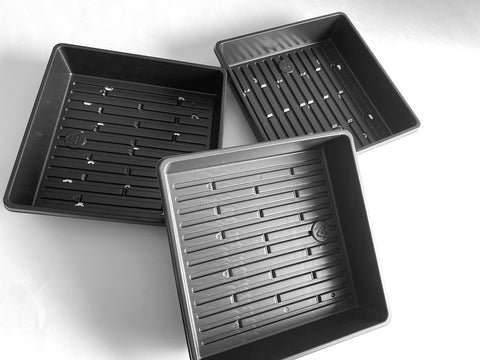
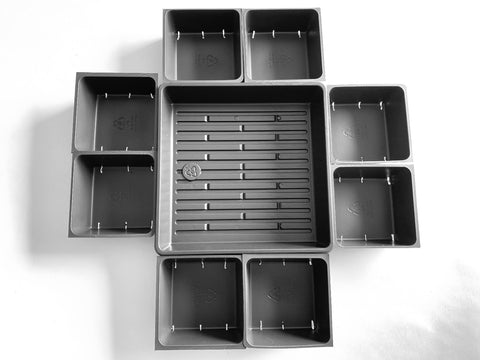
ridges of the Drip Tray. Proceed...
Spread seeds evenly on thoroughly moistened soil/medium.
We use a lot of seeds and though some literature will tell you that your seeds should not ever lay atop each other, we have found from years of experience and thousands of pounds of Greens grown that that is bunk! You will learn for yourself that some
Greens (like these) produce a plant that takes up less room than the seed and so, to maximize your yield, your seeds must lay atop each other to some degree. The thing to watch is this: If you find mold or fungal problems in your
Greens then lessen the amount of seed you plant. The hotter/more humid your climate is the more of an issue the mold/fungus is. As always, you need to adapt to your own climate and seasonal conditions. And learn as you go - this is really easy and fun stuff to learn, and what is better
than learning?!
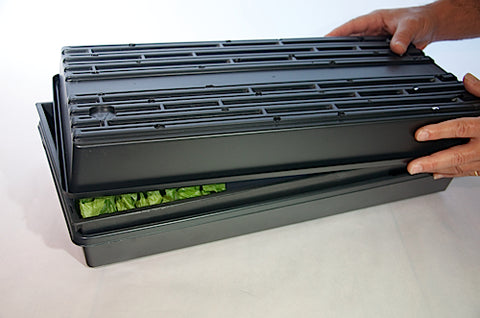
Cover the planted tray
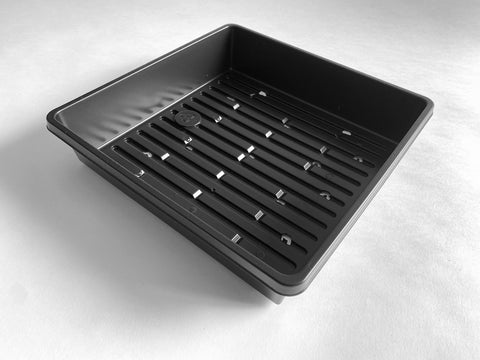
with an inverted tray (the Cover Tray) - to keep light out and moisture in.
Your covering tray should have holes or slits in it so that some air circulation exists. Without this very minimal air flow you might have mold or
fungal problems.
Place in a low-light, room temperature location.
70° is always optimal but these Greens will grow very well in cooler or slightly warmer temperatures also.
Water lightly once or twice a day.
The goal is to keep the sprouts moist until their roots bury themselves in the soil/medium - at which point your goal is to keep the soil/medium moist.
Spraying the sprouts is best - whether you use a garden hose sprayer, hand sprayer or faucet sprayer - just try to make sure that every sprout gets rinsed and quenched until they bury their roots.
You may use Kelp Fertilizer if you like.
Water the medium.
Once the roots are buried all you need to do is keep the medium moist - the seeds and subsequent Greens will get the moisture they need through their roots.
Water from the side if possible, to prevent injuring the tender Plants.
The Soilless alternative.
Vermiculite holds water better than anything, while Baby Blanket will dry out more quickly than soil in most circumstances, so you should either water more often - or - experiment with our somewhat risky
trick:
Use the Drip Tray to hold some water. The roots will actually sit in this, so don't go crazy - too much can drown your plants and/or lead to fungal or mold problems. Just leave as much water as the Greens can drink in a day and then
add more the following day. The amount is dependant on the climate (humidity especially) you're growing in, so you'll have to learn this for yourself. We suggest that you start with 1-2 cups in the Drip Tray.
Lift the Planting Tray to see how much is left after 4, 8 and 12 hours. If the Drip Tray is dry add more water - if there is still water 24 hours later then cut back the next time you add water.
Pretty simple really, and not as risky as we make it sound - it is really a time saver and produces happy healthy Greens.
Once again, we do recommend Kelp Fertilizer enriched water for soilless growers. Soil growers may use it too of course, but the soil does have some nutrients already, so it is not nearly as important for you.
Uncover your Greens.
After 3-4 days, or when they are about an inch tall, or when they push the covering tray up (they really will do that - it is cool!)
Move your crop to a well lit location. If you use direct sunlight (a very good idea for Greens) be prepared to do more watering.
Keep the soil/medium moist by watering the soil/medium daily. Watch them grow.
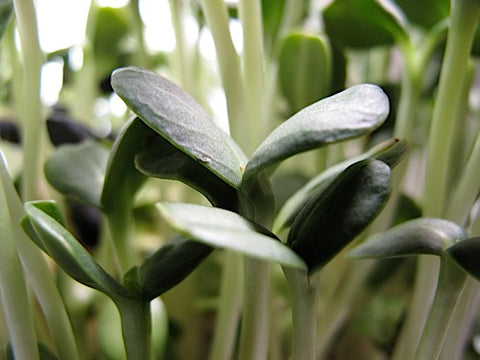
Harvesting your crop is just a matter of cutting the plants when they are about 2-4 inches tall and have green leaves.
Cut the plants just above soil or medium's surface.
Harvest should occur BEFORE "true leaves" begin to show. They are leaves which will appear from the center of the first 2 leaves. If you see a few Greens with these tiny leaves forming then get your scissors out - the Greens get less tasty
(a bit bitter) if left go too long.
Shells: Sunflower Greens will shed their Shells as their leaves open, but there are always some that are slow to shed. We remove the loose ones like this: Take the tray at an angle and brush your hand back and forth over the top of the Greens.
There will be some leaves that are still inside shells. You will either need to peel the shells off of those, or discard those Sunnys. Though you can still eat the stem, eating the shell is generally frowned upon by one's stomach, and is texturally not in keeping with the tender perfection of the other Sunnys.
Refrigerate
If you are going to store your crop; during the final 8-12 hours minimize the surface moisture of your Greens - they will store best in your refrigerator if they are dry to the touch.
So when you water - try to keep the water off the plants - just water the soil/medium, like we said above.
Transfer your crop to a plastic bag - or better yet try our some Produce Storage Bag (they actually extend the shelf life of produce - we use them in our house). Whatever sealed container you choose - put them in your refrigerator.
Sunflowers to start with
* If using Sproutpeople's Single Harvest Pack, use the whole bag on our 5 inch tray (or similar).
Or Use:
1/4-1/3 cup for a 5" square Tray.
1-1 1/2 cup for an 10" square Tray.
2-3 Cups for an 10 inch x 20 inch Tray.
The surest way to know what amount of seed to use:
Spread dry seed on the bottom of that in which you will be growing (i.e. your tray) so that the seed is spread evenly but densely.
Once more time: We use a lot of Seeds and though some literature will tell you that your seeds should not ever lay atop each other, we have found from years of experience and thousands of pounds of Greens grown that that is bunk!
The thing to watch is this: If you find mold or fungal problems in your Greens then lessen the amount of seed you plant next time. The hotter/more humid your climate is the more of an issue the mold/fungus is.
As always, you need to adapt to your own climate and seasonal conditions. And learn as you go - this is really easy and fun stuff to learn!