BIO-SET Sprouter
We no longer offer this item. We used to say...We Sproutpeople don't much like "no-rinse" multi-tiered Sprouters like the Bio-Set. But... Enough of our customers have requested this type of Sprouting Device, to keep us offering it. Please read about it before ordering one.
Bio-Set Sprouting Instructions
Bio-Set can't do this. Prep in something else.
You can Soak in the drip tray/base if you wish.
According to the manufacturer: Fill the top tray (the reservoir tray) with water. After the water has collected in the bottom (drip) tray - discard it (or water plants - or make soup - it has nutrients in it). Always use cool (60 - 70°) water (unless instructed otherwise by your seed supplier).
If you want to have greater success: Rinse each tray by hand - by holding it under your faucet or sprayer. Fill the tray with water and allow it to Drain out the siphon hole. Tip the tray (while keeping your other hand over the sprouts - so they don't fall out) to help.
If you do the Rinse through the top, trickle down thing, you will end up with quite a bit of water remaining in each of the growing trays (That's the way this device was designed. If you are going with the manufacturer's version of sprouting you don't do anything beyond emptying the drip tray.). That water retention is a common concept in stacking European sprouters and is also the worst thing about them, in our opinion. It is never (I suppose I shouldn't say never) a good idea for seeds/sprouts to sit in water! We suggest instead: When you are done Rinsing you need to get as much of the water out of the trays as possible. Tip it until no more water comes out.
When you are growing big seeds it is easy enough to get most of the water out, but when they are small seeds, there will always be some water left, so tip more than you think is necessary. It can't hurt - unless you are trying to grow vertical Leafy Sprouts. If that is what you are trying to do,- good luck!
Sprouting and Greening
Stack your trays - if stacking - after they have been well Drained. Do be aware that air-circulation is reduced in Bio-Set - so Rinse more often or separate your trays if your sprouts ask you too. You'll have to separate the trays if the sprouts grow taller than the trays anyway - which is about the time that reduced air-circulation becomes a serious issue. Don't feel confused - just pay attention to your sprouts! Grow with the flow =;-}
If you are growing sprouts with leaves, uncover trays and locate them where they can get some more light (according to the directions on that seed's detailed information page). Since you are dealing with trays you can get away with more light than when using totally enclosed sprouters. You can even use direct sunlight, but do pay attention as the sun hastens drying and heats up the sprouts, so you might have to Rinse more often with cool water to compensate. Experiment and see. You'll do fine with minimal light too so don't feel like you have to push it.
Seed Specific Sprouting Instructions If you have a particular seed type in mind, read on to discover further details of Bio-Set sprouting that seed type. Refer to the seed's main information page for detailed instructions.
Leafy Sprouts
If you are following the manufacturer's instructions - all we will add is that you should consider Draining The trays by tipping them after every Rinse.
It is virtually impossible to grow vertical Leafy sprouts in Bio-Set. We suggest that you don't even try. Really! You'll have more luck with jumbled sprouts. Assuming you are following our tweaked instructions, on this page - this is what you need to add to the seed information page's detailed instructions: Rinse each tray by hand - by holding it under your faucet or sprayer. Fill the tray with water and allow it to Drain out the siphon hole. Tip the tray (while keeping your other hand over the sprouts - so they don't fall out) to help.
Greening is done according to the directions on the seed information page.
If you have your heart set on vertical Leafy sprouts you really should consider buying SproutMaster instead - it does that job flawlessly!
Maximum dry seed = 4 teaspoons per tray. We suggest you start with 1 Tablespoon, until you are familiar with the crop growing in this device.
Beans
Follow the seed's detailed instructions for the bean you are growing. You may also follow our Bio-Set specific tips (in the section above, entitled Bio-Set Sprouting Instructions) if you like. Maximum dry seed = 2/3 cup per tray. We suggest you start with 1/2 cup, until you are familiar with the crop growing in this device.
Mung Bean
If you are going for small sweet Mungs you need only follow the directions on the Mung Bean information page. If you are going for big and thick the only advice we will offer here is to use the maximum amount of seed - that is the only real chance you have unless you want to add some weight to the Mung growing tray as specified on the Mung instruction page.
Maximum dry seed = 2/3 cup for small sprouts or 1/2 cup for big sprouts per tray. We suggest you start with 1/3 - 1/2 cup, until you are familiar with the crop growing in this device.
Brassicas
These are the worst seeds to grow in a Bio-Set if you follow the manufacturer's instructions. You have been warned!
If you insist on following their instructions, please add this: Break Up/Loosen the mass at every Rinse, beginning around day 3 - or whenever they bunch together, and there after at every Rinse. Just separate them with your fingers or a fork. Brassicas need to move while sprouting or they will form a root mass (beginning around day 3) which is at least unpleasant and often lessens the sprouts' quality. Solution: Break Up/Loosen the mass. Use high water pressure (difficult considering Bio-Set's drainage configuration) or your fingers at every Rinse to keep the sprouts loose. If they mass together despite your efforts (which is not uncommon - especially if you are growing the maximum amount of sprouts Bio-Set can grow), transfer the sprouts to a big bowl or pot type container. Fill the container with cool water (you can also use high pressure water to fill the container if you want to get a head start on loosening) and reach in with your hands (as long as they are clean) or a fork - and gently separate the sprouts. Go ahead and skim any hulls that are floating on top and then transfer your Brassica sprouts back to Bio-Set. You don't have to, but we Rinse again once they are back in their tray. Keep breaking up the mass at every rinse after that as well.
If you just won't believe that Brassicas can't grow vertically, go ahead and try it - there is no better way to learn than through failure - and learning is a good thing (as long as you don't hurt anyone). You should try it with Radish if you must, as it will be the least bad of the Brassicas (it can even produce an edible crop of micro-greens if you get lucky). Just follow the manufacturer's instructions and be sure to uncover and separate the tray from the stack as the crop grows big (once the Greens grow over the top of the tray, the roots have pretty much closed the siphon hole - which means water won't drain - so tip to pour the water out after Rinsing.). Also - your white siphon cap will be swallowed by the roots. Extract it gently after harvest - you NEED it!
I bet you've never seen blue roots before.....
Maximum dry seed = 5 teaspoons per tray. We suggest you start with 1 Tablespoon or less, until you are familiar with the crop growing in this device.
Alliums
Garlic, Leek and Onion. Remember - these all take up to 2 weeks to finish sprouting and they stink to high heaven if left sitting in water - so keep Rinsing or at least Draining manually - at least 2 times a day. Maximum dry seed = 2 Tablespoons per tray. We suggest you start with 4 teaspoons, until you are familiar with the crop growing in this device.
Grains
As with other big seeds, the big grains will work - even with the manufacturer's instructions. Draining manually never hurts, but these will work in any case as they are too big to fit between the grooves on the bottom of the trays. Follow the seed information page instructions for the grain you are growing.
Maximum dry seed = 1 cup per tray. We suggest you start with no more than 3/4 cups, until you are familiar with your crop and device.
Nuts, Seeds and Pseudograins
If big seeds (Almond, Peanut, etc.) you are sprouting, follow the seed information page instructions for the nut or seed you are growing. If you are growing small seeds like Amaranth and Quinoa - then add at least, the manual Draining to that seed's sprouting routine.
Maximum dry seed = 3/4 cup per tray for the big seeds, 1/2 cup for the small seeds. We suggest you start with no more than 75% of the maximum capacity, until you are familiar with your crop and device.
Grass and Greens
Because the Bio-Set holds moisture well it makes it possible to grow grass and greens without soil. Doing so always requires extra attention but as long as you keep the seeds moist all through growing, it can be done. WE ARE NOT suggesting this as a good way to grow these crops but we are saying that it is possible. Experiment Freely! The major problem is that the roots will grow around the siphon cap - in a big way. Be sure to find the white siphon cap before discarding the root mass - you need it for Bio-Set to work!
Based on our experience - Grass holds better hope for success.
Bio-Set is a good enough Pre-Sprouter for big seeds!
Maximum dry seed = 1 cup per tray for Pre-Sprouting. If you want to grow all the way: Determine how much seed to soak by spreading dry seed evenly on the bottom of the tray. If you evenly cover the bottom of the tray with dry seed, you'll have the right amount of soaked seed to grow Grass or Greens.
Micro-Greens
Pre-Sprouting only unless you want to try the blue-rooted Radish experiment. I'm sorry - I'm so negative about Bio-Set! The Radish may actually grow quite well. The problem is that novice sprouters will encounter so many problems with this device that many will give up sprouting forever. We can't stand that! We need you all to enjoy sprouting and too keep doing it - forever!
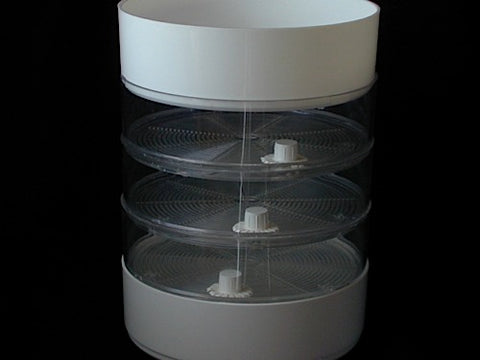
The best loved European tray sprouter, Bio-Set is supposed to do some of the work of sprouting for you - by helping with the Rinsing and Draining. It has 3 growing trays.
Bio-Set isn't like our other tray sprouters. It is a siphon sprouter (like Biosta - a sprouter we no longer sell), which works on the principle of retained high humidity. We are big on Rinsing, Draining and air-circulation, so we are generally at odds with this concept.
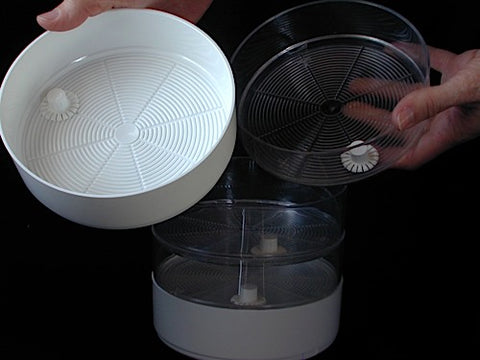
According to the manufacturer's directions: Water enters the Bio-Set by filling the top tray - the reservoir tray as we call it. The water then siphons down to the lower trays - one by one - through the siphon holes, and ends up in the drip tray at the bottom of the stack. The concept is this: Water is retained in the grooves on the bottom of each growing tray, creating humidity, theoretically conducive to sprouting.
The Bio-Set is 8 1/4 inches tall, 6 inches in diameter. It has three 1 1/2 inch tall, clear growing trays, a white drip tray and the top reservoir tray - where you add water - also white. The bottom of each tray is full of grooves. Water remains in those grooves and because of the sealed nature of the device, creates the high humidity desired. In theory your seeds will germinate in this very humid space. The problem is that, when your seeds are small (Leafy Sprouts like Alfalfa and Clover, small Brassicas like Broccoli and Mustard, etc.) - they sit in the grooves, and therefore in water. In our experience, a seed that sits in water will rot before it germinates.
Though we are generally opposed to this concept - it can work. Big seeds (like Beans and Grains do quite well, because they are too big to sit under-water in the tray's grooves. Little seeds can work too, if you are either lucky, less demanding (willing to accept a high percentage of un-sprouted seeds), or willing to Rinse and Drain each tray manually 2-3 times daily like our favorite European tray sprouter Bio-Salad or our favorite tray sprouter of them all - SproutMaster. Bio-Set is also good at growing Grass, and growing Radish into Micro-Greens, but the roots of those plants will cause problems for your Siphon Caps. The Siphon Caps can get so intermingled with the roots that they either get lost or broken when you try to get them out.
Growing Capacity Per Tray : 1.5 Cups of Sprouts. Each tray can yield approximately 6-8 ounces of Leafy Sprouts or 12 ounces of Bean or Grain sprouts.
FOR USE WITH THESE SEEDS/CROPS
These seeds are the Best match for Bio-Set:
Beans - All (see Mung Beans - under Seed Specific Sprouting Instructions, further down the page).
Mung Beans - We suggest that you stay with small and sweet Mungs when using Bio-Set.
Grains - All, except for Amber Waves of Grain (because of its small seeds).
Possibilities:
Leafy Sprouts: Alfalfa/Clover and Mixes - If you really want to grow these little seeds you should consider Rinsing and Draining the tray manually - by tipping it after every Rinse, to get as much water out as possible - as you would with Bio-Salad or SproutMaster. If you want to grow vertical Leafy Sprouts use SproutMaster.
Brassicas - Broccoli, Radish, Mustard, Cabbage, etc. If you really want to grow these little seeds you should consider Rinsing and Draining the tray manually as you would with Bio-Salad or SproutMaster. Remember: Keep these Brassicas from forming a mass.
Exotics - Garlic, Onion, Fenugreek These really will do better if you do your Rinsing and Drain manually. Alliums that sit in water produce an amazingly strong smell which virtually no human being likes in their house! Fenugreek is big enough to stay out of the grooves, but may not thrive in such a humid climate.
Nuts, Seeds and Pseudograins - Almonds, and Peanuts will work best. Sunflower and Pumpkin may not do well in the high humidity. The little seeds - like Quinoa and Amaranth will be drowned in the water - so you'll need to Drain manually if you are growing them.
Pre-Sprout - Acceptable and Possibilities:
Grass and Greens - Because the Bio-Set holds moisture well, it makes it possible to grow grass and greens without soil. Doing so always requires extra attention but as long as you keep the seeds moist all through growing, it can be done. WE ARE NOT suggesting this as a good way to grow these crops but we are saying that it is possible. Experiment Freely! The major problem is that the roots will grow around the tray's siphon cap - in a big way. Be sure to find - and very carefully extract the white siphon cap before discarding the root mass - you need those caps for Bio-Set to work!
Do Not even bother trying Sunflower Greens - they taste terribly bland when grown without soil (our opinion).
Pre-Sprouting is best with big seeds that won't fall into the tray's grooves.
Impossible:
Micro-Greens - I hate to tell you that anything is impossible, but since Micros are grown from small seeds, and they need to stay in one place to grow vertically - I just can't see them working in a Bio-Set. The one exception to that is Radish - the biggest of the Micro-Greens seeds.
Notes
Cleaning
Scrub well between crops with soap and water. Be sure to get into the grooves on every tray! Rinse well! We do this every crop because a clean sprouter produces better sprouts.
Scrub and soak in some disinfectant. We don't do this often because regular soap does the trick nicely, but a sterile sprouter is a great place to begin a crop.
* If you have a Biosta (we don't sell them anymore) you can follow the instructions on this page pretty much word for word. The only differences between the two is that when you add water to Biosta it goes directly into the top growing tray while water added to the Bio-Set is added to the reservoir tray.
Adjust accordingly. Biosta is also larger, having about twice the capacity per tray as Bio-Set.
I love these! I just incorporate the rinsing into my day. Morning, afternoon and bedtime. I rinse, drain well and re-stack.
It is terrible with broccoli and alfalfa so I do those in jars. But radish, adzuki, sunflower all preform well in this sprouter.
NOTE: I do NOT use this sprouter as the manufacturer recommends. I tried that. It was a huge FAIL. But when I rinse the individual trays manually (allowing the siphon drain to drain excess a couple of times per rinse ( and I also prop the trays along the edge of my sink with one side elevated to send all of the excess water to the drain before I re-stack them).
I love these! I just incorporate the rinsing into my day. Morning, afternoon and bedtime. I rinse, drain well and re-stack.
It is terrible with broccoli and alfalfa so I do those in jars. But radish, adzuki, sunflower all preform well in this sprouter.
NOTE: I do NOT use this sprouter as the manufacturer recommends. I tried that. It was a huge FAIL. But when I rinse the individual trays manually (allowing the siphon drain to drain excess a couple of times per rinse ( and I also prop the trays along the edge of my sink with one side elevated to send all of the excess water to the drain before I re-stack them).
We have awful problems with drain flies and fruit flies. The flies are very attracted to my sprouts. The Bio-Set worked so well that I bought a second one and stacked it together with the first. For small seeds I bought small clay trays (the kind that go under garden pots) and placed them in the Bio-Set. When I pour water through the Bio-Set, the water comes up to the edge of the tray, but does not flood it. The clay tray absorbs enough water to keep the sprouts growing. The Bio-Set keeps the flies out. Mung beans work great without any modifications. I love my Bio-Set.
We have awful problems with drain flies and fruit flies. The flies are very attracted to my sprouts. The Bio-Set worked so well that I bought a second one and stacked it together with the first. For small seeds I bought small clay trays (the kind that go under garden pots) and placed them in the Bio-Set. When I pour water through the Bio-Set, the water comes up to the edge of the tray, but does not flood it. The clay tray absorbs enough water to keep the sprouts growing. The Bio-Set keeps the flies out. Mung beans work great without any modifications. I love my Bio-Set.
I have had a sprouter like this one for more then 17 years. I paid just over $12.00 for it at my local health food store. The price asked for it now is truly ridiculous. I was looking to get another one, but not at these prices.